Choose your preferred language above, then press Refresh Translation to translate this page.
NUKU-ROA
[Land of the Rising Sun — First in Time, Best in LORES]
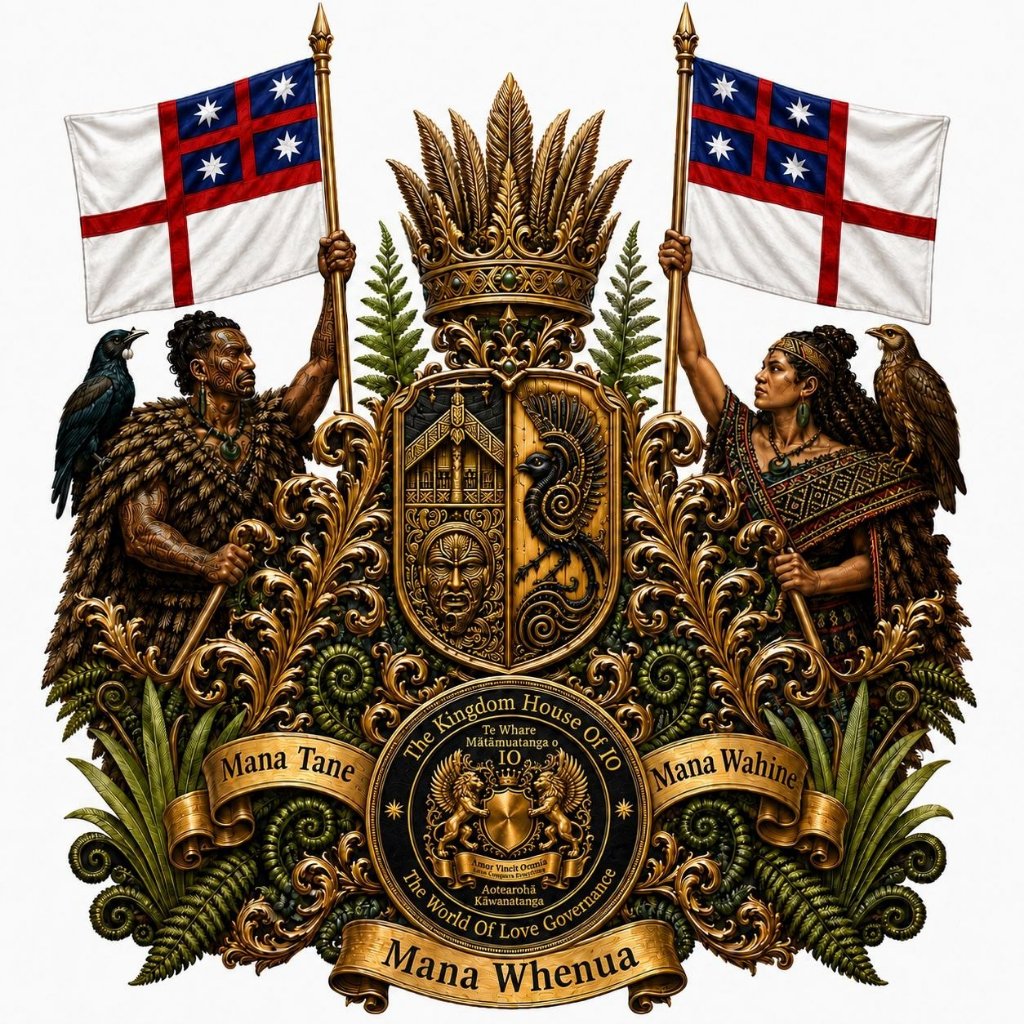
NGĀ WHARE ARIKI
[Te Tohu me tōna Whakamāramatanga — The Symbol and Its Explanation]
Section
Te Tikanga Katoa
[The Complete Meaning]
Mana
- ◆Authority and power: An inherited and spiritual source of power, prestige, and jurisdiction.
- ◆Responsibility: The duty to protect, nurture, and manage people, resources, and places correctly.
Tangata Whenua
- ◆People of the land: The local indigenous group, iwi (tribe), or hapū (sub-tribe) tied to a specific area through whakapapa (genealogy) and ancestral history.
- ◆Custodianship: Those who hold the primary right and obligation to care for the local environment and host visitors.
Rangatira
- ◆Chief or leader: A person of high rank who guides the community.
- ◆Noble qualities: True leadership defined by a deep care for the integrity, prosperity, and well-being of the people and the land.
Section
A–Z Words & Meanings
[Glossary of Sacred Terms]
Arikitanga
Monarchy.
Arohā
Love, compassion, empathy, and affection. It is a deep and broad concept that goes beyond simple romance to include human connection, empathy, and caring for others.
Kaitiakitanga
Guardianship, stewardship, trusteeship, trustee, trust.
Kotahitanga
Unity, togetherness, solidarity, collective action. Māori Parliament, Federated Māori Assembly — a movement for self-government and national unity among Māori kinship groups during the 19th Century. Strong in the Wairarapa where two parliamentary meetings were held at Papawai in 1897.
Mana tāngata whenua rangatira
Translates to the spiritual authority, customary rights, and leadership of the indigenous people of the land.
Mana Whenua Tuku Iho and Taonga Tuku Iho
From a Māuri worldview, mana whenua tuku iho and the kaitiakitanga authority over land, taonga tuku iho literally mean the collective treasures of our ancestors. In a metaphoric sense they refer to the accumulated knowledge and cultural aspirations Tāngata Māuri have for themselves and for their future generations.
Manaakitanga
Hospitality, kindness, generosity, support — the process of showing respect, generosity and care for others. Manaaki — to support, take care of, give hospitality to, protect, look out for — show respect, generosity and care for others.
Māuri
(noun) Life principle, life force, vital essence, special nature, a material symbol of a life principle, source of emotions — the essential quality and vitality of a being or entity. Also used for a physical object, individual, ecosystem or social group in which this essence is located.
Māuri mana motuhake
Combines māuri (the life force or essence), mana (authority, power, or spiritual prestige), and motuhake (separate, independent, or autonomous) to mean an independent, self-determined life force and authority over one's own destiny. It describes sovereign self-control and distinct cultural identity. (noun) separate identity, autonomy, self-government, self-determination, independence, sovereignty, authority — mana through self-determination and control over one's own destiny.
Suverän
A supreme lord or ruler; one who possesses the highest authority without control. Some kings are Suveräns in their dominions; the authority of others is limited. The Creator is the Suverän of all that he has made. ... A supreme magistrate, lord or king.
Tino Rangatiratanga
(noun) Self-determination, sovereignty, autonomy, self-government, domination, rule, control, power.
Whakataukī
Metaphors that support critical thinking by allowing the receiver of the whakataukī to consider another way of thinking from a worldview other than their own. To affirm whakataukī is to accept the indigeneity of a Māuri/iwi lens and invites the receiver to align their thought processes to this.
Whanaungatanga
Relationship, kinship, sense of family connection — a relationship through shared experiences and working together which provides people with a sense of belonging. It develops as a result of kinship rights and obligations, which also serve to strengthen each member of the kin group. It also extends to others to whom one develops a close familial, friendship or reciprocal relationship.
Section
The Emblem
[Symbolism of the Emblem]
Emblem
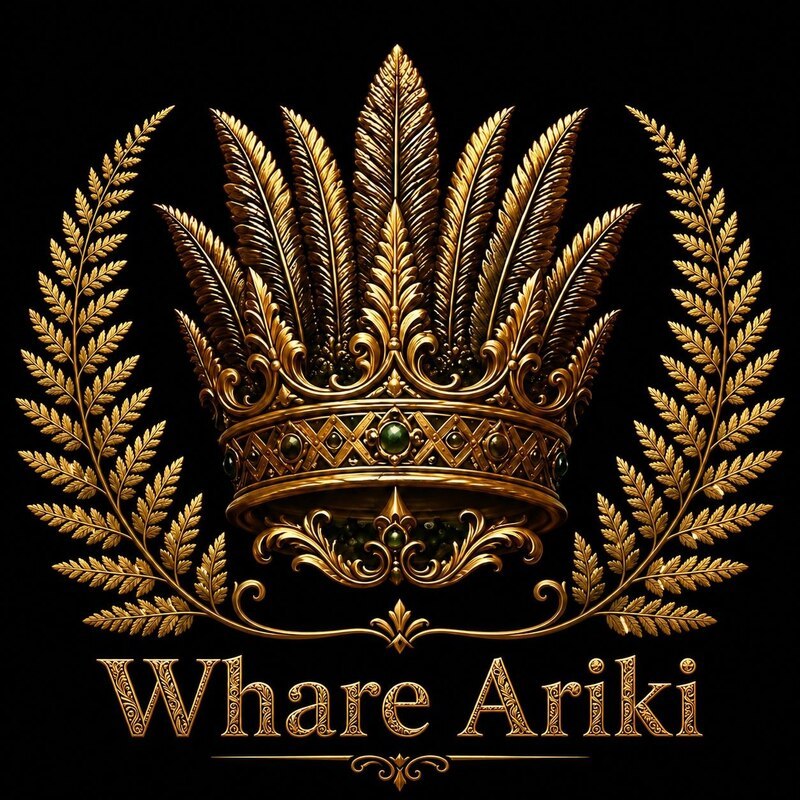
Te Whare Ariki emblem represents the royal house, royal family, or noble lineage, headship, mana motuhake authority or spiritual power, separate identity, autonomy, and self-determination, wisdom, knowledge, spiritual enlightenment. It further symbolises Arikitanga, Paramount Leadership, guardianship, service, honour, integrity, dignity, responsibility, and the obligations carried by those entrusted with Headship. It symbolises the sacred transition from Te Ao Wairua [Spiritual World] and acknowledges the mana [supreme authority] and standing of every participating Ariki [Paramount Chief] and Ngā Whare Ariki [Royal Houses]. Each Whare has its own sacred genealogy known only by them.
Crown
A single central feather stands at the centre of the headpiece — Flanking the central feather are six visible feathers, three on the left side and three on the right side. Behind the visible feathers are six additional feathers that are concealed from frontal view and cannot be seen when viewing the emblem from the front. 13 feathers in total around the crown of the head. Together, the six visible feathers, the six concealed feathers, and the central feather comprise the thirteen feathers of the 13 dimensions where IO resides. The central feather represents the Thirteenth Rangitūhaha [the Thirteenth Dimension], the highest point of connection, unity, consciousness, and return. Together, the twelve surrounding feathers and the central feather comprise the Thirteen Rangitūhaha of IO Te Rangitūātinitini [IO of the Infinite Dimensions] and symbolise the journey of consciousness, Mauri [Life Force], and lived experience throughout the many dimensions of existence, of which are infinite.
Gold
Gold symbolises honour, wisdom, knowledge, excellence, achievement, prosperity, permanence, and legacy. Within United World Tribes it represents the value placed upon whakapapa [genealogy / ancestral lineage], sacred knowledge, leadership, lived experience, cultural continuity, and future generations. Gold symbolises the light of knowledge emerging into the world through service, leadership, and experience.
Black Background
Black symbolises Āio Te Korekore [Eternal Peace throughout Eternity], dignity, strength, sacredness, permanence, formality, and timelessness. It provides the lived experience foundation upon which the gold elements emerge. The contrast between black and gold symbolises knowledge, wisdom, leadership, and consciousness emerging from the deeper mysteries of existence.
Mauri
Mauri [The Eternal Life Force] is the spiritual life force that moves throughout the entire emblem. Unlike the other elements of the emblem, Mauri is not confined to a single symbol or position. It flows through the entire emblem — the Kōrūrū, Manukura, the Pōhutukawa Kōwhai Wreath, the interwoven relationships, and all participating Whare Ariki. Mauri is the living presence that gives movement, vitality, purpose, and life to the whole. It connects IO, Te Kōtahitanga Ō Ngā Whare Ariki, the participating Whare Ariki, and the pursuit of higher consciousness. Mauri is experienced through living, observing, participating, relating, serving, learning, and growing. It is not merely understood intellectually but known through direct lived experience. Without Mauri, the emblem is merely a collection of symbols. With Mauri, the emblem becomes living, relational, and active. Mauri therefore represents the spiritual life force of IO that flows through all things and unites the various elements of the emblem into a single living expression of Te Kōtahitanga Ō Ngā Whare Ariki [Unity].
The Ferns
They present humility, sincerity, and God's hidden grace.
Section
The Numbers
[Sacred Numerology]
The numbers associated with IO within this symbolism are 1, 0, 10, 12, and 13. Together, these numbers express the movement from source, through potential, into manifestation, throughout the dimensions of existence, and ultimately back into unity. For this reason, it stands not only as a symbol of birth, leadership, and Arikitanga, but also as a representation of the thirteen dimensions through which consciousness, experience, and Mauri move.
Represents the singular source.
Represents Te Korekore [the Void / the infinite field of unlimited potential].
Represents completion and return to unity.
Represents the Twelve Rangitūhaha, the dimensions through which consciousness, Mauri, experience, and creation move and are expressed.
Represents the Thirteenth Rangitūhaha, the highest point of connection, unity, consciousness, and return.
Section
Eyes [Kanohi]
[The Divine Gaze]
The phrase "the eyes of Io supreme" connects to indigenous Polynesian and Māori traditions regarding Io, the supreme deity and ultimate origin of life, as well as involving all-seeing divine gazes.
Māori Tradition
Io-matua-kore is viewed as the parentless, supreme source of all life and sacred knowledge, whose unseen presence and spiritual order watch over the cosmos.
Alternative Meanings
Similar phrases refer to apocalyptic "supreme eyes" or celestial entities capable of perceiving or erasing all existence.
Section
Origin — Star Seeds
[Celestial Origins]
We are Purapura Whetū
Whetū means star in Te Aka Māori Dictionary, connecting us to the celestial origins, ancestors, and the traditional navigation and stories written in the night sky.
Tupuna (Ancestors)
In Māori tradition, those who pass on are often seen as returning to the heavens, becoming stars like Pōhutukawa in the Matariki cluster.
Purapura Whetū
Known as star seeds or stardust, representing our fundamental connection to the universe.
Navigation and Time
Stars served as vital indicators for planting, harvesting, and voyaging across the vast ocean.
Section
Matariki
[The Pleiades Cluster]
(personal noun) Pleiades, Messier 45 — an open cluster of many stars in Te Kāhui o Matariki, with at least nine stars visible to the naked eye. The brightest star in the centre of the cluster, also known as Matariki (Alcyone), married Rehua (Antares) and is the mother of the other eight stars of the Pleiades known to Māori. The first appearance before sunrise of Matariki in the north-eastern sky, in the Tangaroa phase of the lunar month, indicates the beginning of the Māori year — about mid-June — and is the cause for celebrations. Matariki disappears at the end of the Māori year and traditionally this was also a reason for celebration with some iwi. During this time when Matariki was absent from the sky, she was said to visit four places, each for seven nights: Maukahau, Tārarau-ātea, Papa-whakatangitangi and Tītore-māhu-tū. Matariki is a truncated version of the name Ngā Mata o te Ariki Tāwhirimātea (the eyes of the atua Tāwhirimātea). Matariki is associated with good health and wellbeing.
Tupuārangi
[Atlas]
Waipunarangi
[Electra]
Waitī
[Maia]
Ururangi
[Merope]
Tupuānuku
[Pleione]
Waitā
[Taygeta]
Pōhutukawa
[Sterope]
Hiwa-i-te-rangi
[Calaeno]